eSAM - Invigilation and alerts
The article outlines how eSAM integrates with Teams for remote exam invigilation, detailing setup, alerts, and monitoring features. It explains how to manage student participation and monitor their activity during exams.
Two tabs work together: Invigilation sets up remote invigilation and how eSAM behaves when a student's attention moves away from the exam, and Alerts decides how much of that is worth telling you about.
Teams invigilation
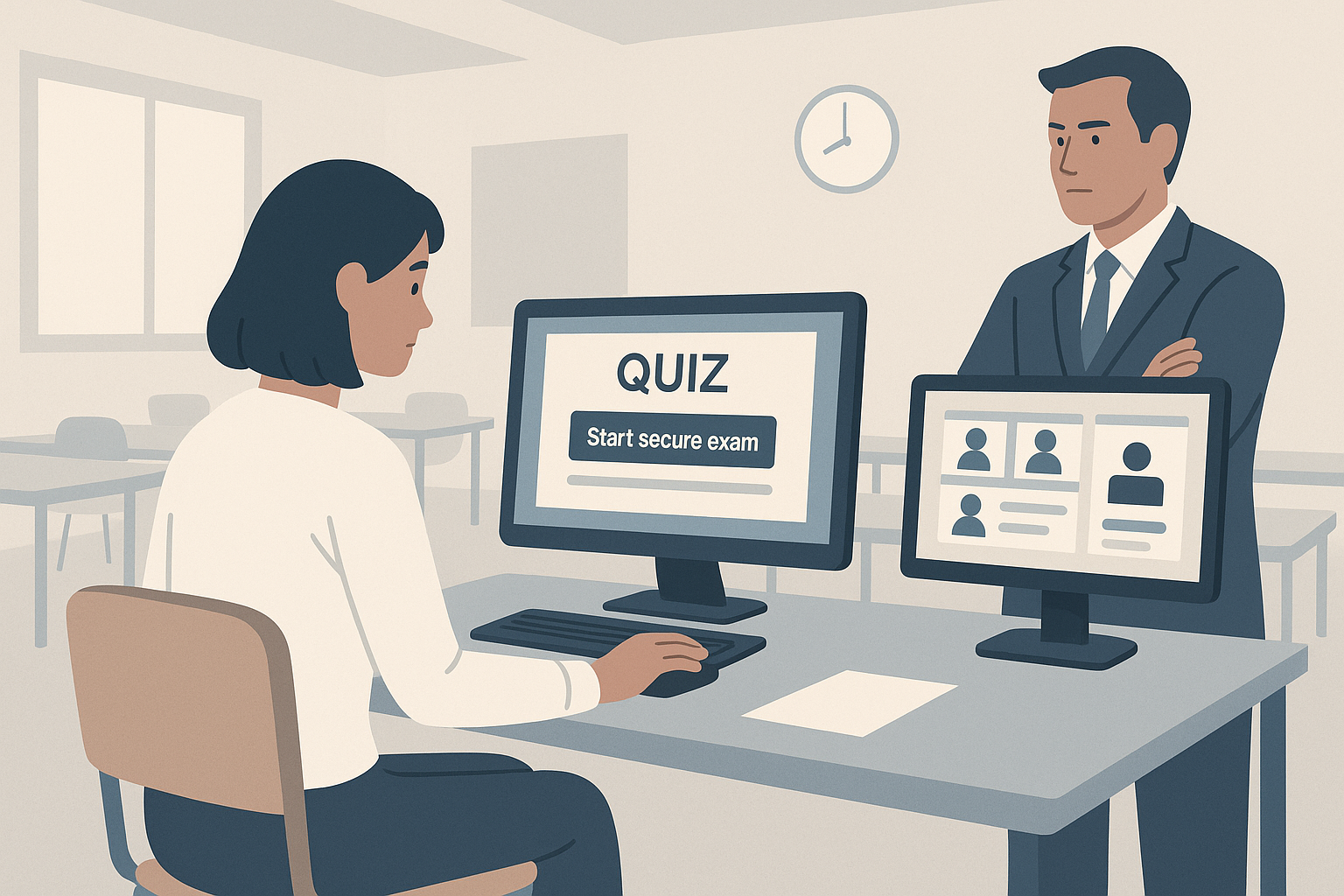
If you invigilate remotely, students join a Teams meeting in normal Windows before they start the exam, so you can admit them from the lobby and check ID. eSAM then keeps that meeting alive alongside the locked-down exam.
Tell students to join in the Teams app beforehand. It is the call they are already in, with their camera and microphone already chosen, and eSAM simply brings it forward when they ask for it. A student who has no Teams running gets the meeting in a window of eSAM's own instead, which works but is the fallback rather than the plan.
Setting it up
- Create the Teams meeting as you normally would.
- Copy the join link.
- Paste it into Invigilation on the exam's eSAM page.
- If your students are split into groups with different invigilators, add a link per group as well.
- Save.
The link appears on the quiz page as Join invigilation meeting, above Start secure exam.
eSAM only accepts a genuine Teams address. If it refuses your link, check you copied the join link rather than a calendar or recording link.
Recommended meeting options
- Lobby on, so you admit students yourself.
- Attendees cannot chat.
- Attendees cannot share their screen.
- No recording by attendees.
What it means for the exam
- Teams invigilation requires the Standard desktop screen mode. eSAM sets this for you.
- Students get Join the invigilation meeting in the exam menu, which brings the meeting to the front. Choosing it again puts the meeting behind the exam, so they can answer questions with the call still running.
- Network lockdown, if the exam uses it, stands aside for the meeting. A lockdown that kills the invigilation call would be worse than a looser one.
- The dashboard shows whether each student's Teams, camera and microphone are running, and you can send a message that brings their Teams window forward.
- When the exam ends, eSAM does not close Teams. Tell students when they may leave the meeting.
One honest limitation. The Teams, camera and microphone checks read the installed Teams app. A student in the meeting inside eSAM instead may show as Teams not running, and their camera and microphone may not register, even though they are plainly on your call. Look at your meeting before you act on those alerts, and tell students to join in the app beforehand — it is the simplest way to keep the dashboard telling you the truth.
Be aware that screenshots taken during the exam will include the Teams window, and may include other candidates' video tiles. Your college's privacy notice should say so.
Alerts
An alert appears on the live dashboard as soon as the eSAM client reports the behaviour. Thresholds decide how much of it is worth interrupting you for.
Repeats of the same problem fold into one alert with a count, rather than arriving one after another. That is deliberate: forty focus alerts from one student's calculator is one thing to deal with, not forty. Alerts also name what they are about — a blocked program alert says which program.
The alerts eSAM raises include:
- Exam window lost focus — something else came to the front. The threshold is how many seconds before you are told.
- Blocked software was found — a browser, a remote-access tool, a recorder.
- Remote access was detected and Exam is running in a virtual machine.
- More screens than allowed.
- Lost contact with the student's PC, and Poor connection.
- eSAM files do not match the release and the background service stopped — both serious, both rare.
- Teams alerts: Teams is not running, camera is not in use, microphone is not in use, Teams window in front for a long time.
- Pre-exam check gave a warning, so you see on the dashboard what a student was told at the start.
- A student raised their hand. This one is not a threshold: it shows the moment they ask, on the dashboard and on the screens wall, and stays until you clear it.
Setting thresholds
Each threshold comes with a sensible default and a range. Set them for the exam you are actually running:
- Supervised in a room: raise the thresholds. You can see the room; you do not need a message every time someone glances away.
- Remote with Teams: lower them. The dashboard is most of what you have.
- An exam where an allowed app is used constantly — a calculator, say — expect focus alerts and set the threshold accordingly.
An alert nobody acts on trains everyone to ignore alerts. It is better to be told about five things you will deal with than fifty you will not.
person people found this useful.